
However, parents should look beyond appearance when choosing a children’s hoverboard. Rider weight, model specifications, experience, protective equipment and the place where the board will be used are all important considerations. In this guide, we explain what parents should check before buying and how to make a more informed choice.
1. Start with your child’s weight, not just their age
One of the most important things to check when choosing a hoverboard for a child is the manufacturer’s recommended rider weight. Age alone does not tell you whether a particular model is suitable.
Self-balancing hoverboards use sensors to respond to changes in the rider’s weight and movement. If a rider is below the model’s minimum weight requirement, the board may not respond as intended. This can make it harder to balance and control.
Every model can have different requirements, so check the individual product listing and manufacturer’s instructions before ordering. Do not assume that a smaller-looking hoverboard is automatically suitable for a younger child.
2. Check the recommended age and supervision guidance
Once you have checked the weight limits, look at the manufacturer’s recommended age guidance. Consider your child’s coordination, confidence, ability to follow instructions and experience with balance-based activities.
Some children may feel comfortable learning new movements, while others may need more time and support. There is no need to rush the learning process. A parent or responsible adult should supervise beginners and make sure the child understands how the hoverboard operates before attempting to ride.
If the product instructions state that a model is unsuitable for a particular age group, follow that guidance. Never choose a hoverboard simply because a child likes its colour or design.
3. Choose the right wheel size and design
Hoverboards are available in different wheel sizes and designs. The wheel size can affect the overall dimensions, ground clearance and intended use of the board. Some models are designed primarily for smooth, level surfaces, while other designs may have features intended for different private riding environments.
Parents should compare the specifications of the individual models rather than assuming that bigger wheels are always better. Consider where the child will be riding, the surface conditions and the manufacturer’s recommendations.
Appearance can still be part of the fun. LED lights, colourful finishes and distinctive wheel designs are popular with younger riders. Just make sure that the model’s practical specifications come first.
4. Look for clear battery and charger information
A children’s hoverboard is still a powered electronic product, so battery and charging safety matter just as much as they do for an adult’s model.
Check that the hoverboard comes with the correct charger and clear instructions. Parents should understand the recommended charging process and make sure the child does not attempt to charge the board independently unless this is appropriate and supervised.
Use the supplied charger or a replacement specifically approved by the manufacturer. Charge in a suitable location, keep the board uncovered and away from combustible materials, and do not leave it charging unattended or overnight. Stop using the board if the battery appears damaged, unusually hot, swollen or produces an unusual smell.
For more detailed advice, read our guide to hoverboard battery care, charging and storage.
5. Protective equipment should be part of the purchase
Learning to ride a hoverboard takes practice. A child may need time to become comfortable stepping onto the footpads, maintaining balance and controlling movement. Protective equipment is therefore an important consideration.
We recommend that parents consider:
- A correctly fitted and suitable helmet.
- Wrist guards to help protect the wrists during a fall.
- Knee pads.
- Elbow pads.
- Suitable footwear that provides a secure fit.
Protective equipment should be properly fitted and used in accordance with its instructions. It does not remove the risk of injury, but it is a sensible precaution when learning a new activity.
6. Give beginners time to learn
A first hoverboard experience should be about confidence rather than speed. Choose a flat, dry and open private area with plenty of space. Keep away from steps, steep slopes, roads, vehicles, pedestrians and obstacles.
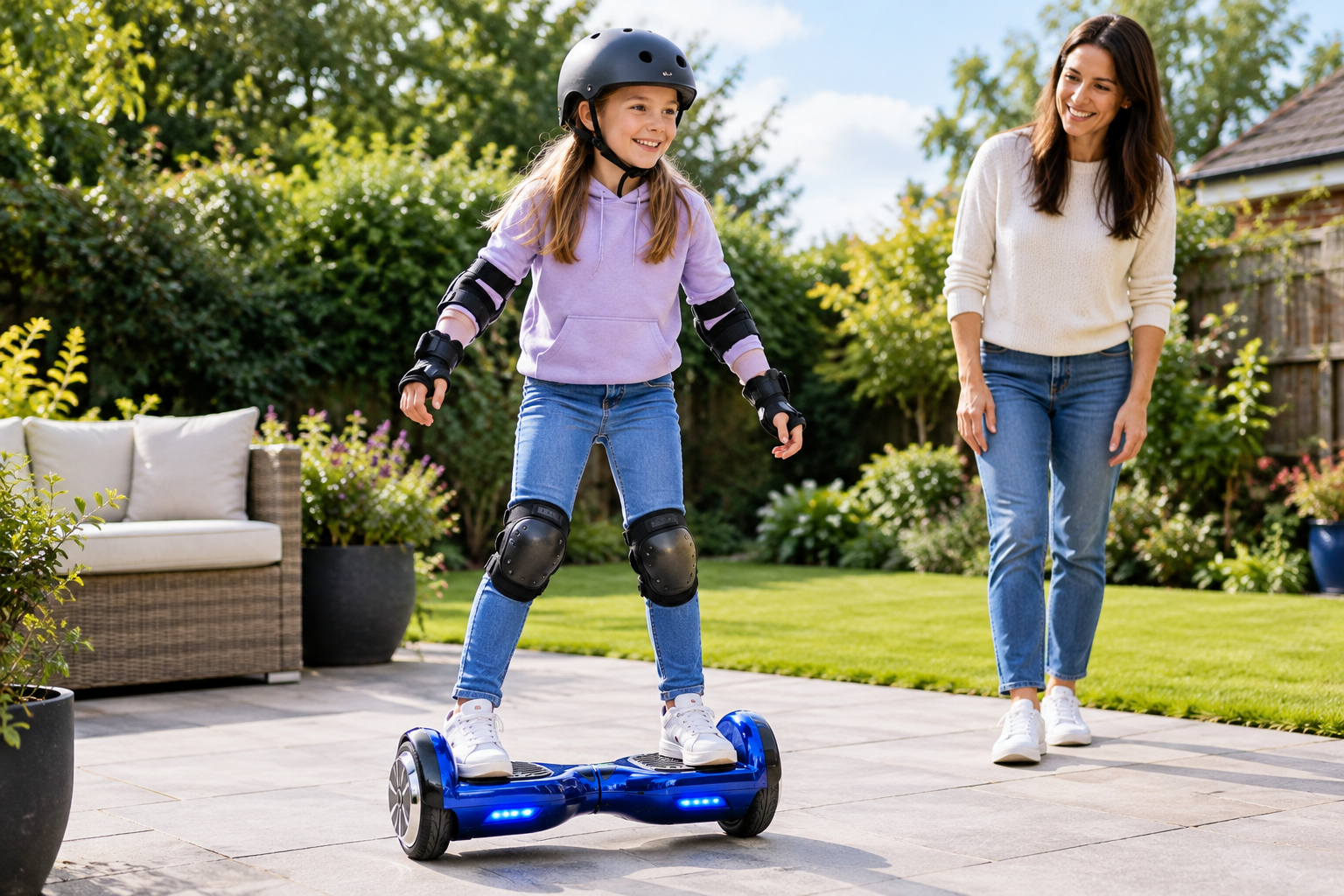
Start by reading the instructions together. Explain how to switch the board on and off, how the controls respond and how to step on and off safely. Stay close while the child practises and allow them to progress at their own pace.
Do not encourage beginners to attempt sharp turns, sudden movements or high speeds. If the child becomes tired or uncomfortable, stop and try again another time.
7. Consider whether a hoverkart is a better option
Some families also consider a hoverkart attachment. A hoverkart converts a compatible hoverboard into a seated, go-kart-style setup using a frame and steering handles.
This offers a different riding experience from standing on a conventional hoverboard and may appeal to children who prefer a seated position. However, compatibility, rider weight limits and age guidance still matter. Check the instructions for both the hoverboard and the kart attachment before buying.
You can explore our hoverboard and hoverkart bundles to see the available options.
8. Understand where children can legally ride a hoverboard in the UK
This is an important point for parents buying a hoverboard in the UK. Privately owned hoverboards are generally treated as powered transporters under current UK guidance. Their use on public roads and pavements is restricted. Riding on private land requires the landowner’s permission.
Before buying, think about whether you have a suitable private area where your child can practise. Do not assume that a pavement, public park, cycle lane or publicly accessible car park is an appropriate place to ride.
For the latest information, read the official GOV.UK guidance on powered transporters.
9. Choose a retailer that provides clear product support
When buying a hoverboard for kids, parents should be able to find clear product specifications, warranty information and contact details. Check what is included in the box, how delivery works and what support is available if you have a question after the purchase.
At HOVERBOARD-PRO, all our hoverboards include a 12-month warranty. We also offer free guaranteed next-day DPD delivery to UK mainland addresses, subject to our delivery terms.
We recommend reading the product description carefully and contacting us if you need help understanding the differences between models. Choosing a board that matches the child’s weight and experience is more important than selecting the most expensive or most colourful option.
Frequently asked questions about hoverboards for kids
What age can a child use a hoverboard?
There is no single age that applies to every hoverboard. Check the manufacturer’s recommended age guidance and minimum rider weight for the exact model. A child’s coordination, confidence and ability to follow instructions should also be considered.
What is the minimum weight for a children’s hoverboard?
Minimum rider weight varies between models. Always check the product specifications and manufacturer’s instructions. A child who is below the stated minimum weight may find that the board does not respond correctly.
Should children wear helmets on hoverboards?
We recommend a correctly fitted helmet along with suitable wrist, elbow and knee protection. Children should also wear appropriate footwear and be supervised while learning.
Are hoverboards safe for children?
Hoverboards are powered electronic products and riding involves a risk of falling. Parents should choose a suitable model, follow the manufacturer’s guidance, provide protective equipment and supervise beginners. No hoverboard should be described as risk-free.
Can children ride hoverboards on UK pavements?
Ordinary privately owned hoverboards cannot generally be ridden on public pavements or roads under current UK powered transporter guidance. Use on private land requires the landowner’s permission.
Is a hoverboard and hoverkart bundle worth considering?
A bundle can provide the option of standing and seated riding, provided the products are compatible. Check the weight and age guidance for both items before purchasing.
Find the right hoverboard for your child
Choosing a hoverboard for kids should be an enjoyable experience, but it is worth taking time to compare the specifications and understand the manufacturer’s recommendations. Check rider weight limits, age guidance, battery information and protective equipment before making your decision.
Explore the range at HOVERBOARD-PRO and browse our hoverboards for sale in the UK and hoverboard and hoverkart bundles. Every hoverboard includes a 12-month warranty, with free guaranteed next-day DPD delivery to UK mainland addresses, subject to our delivery terms.
Choose carefully, follow the instructions and make sure your child’s first riding experience starts with the right preparation.